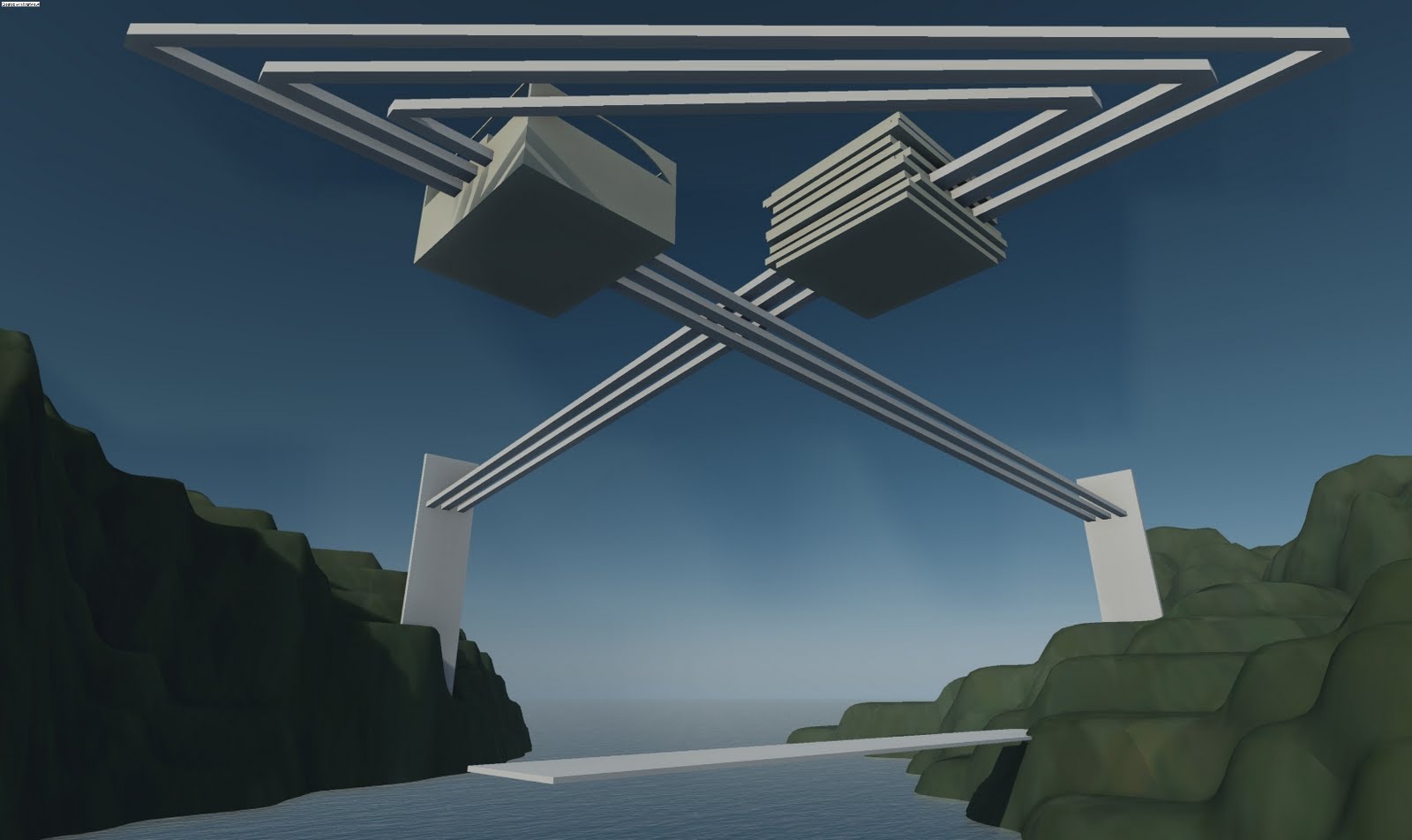
These are the five real-time images taken inside Crysis of my completed bridge and elevator architecture for Angela Merkel and Helen Keller.


Power, as a human expression, can be expressed by distinctive and significant scale. I have explored an architecture that would be near-impossible to reproduce in reality. That is the essence of power - to make the impossible, possible; to convince the masses, for a fleeting second, that reality is what you dictate, and not what it is in reality.


Parts of my architecture express a resounding uniformity in form and function. The impact of power upon those whom it is impressed upon is magnified when it is reinforced by repetition. The first Roman emperor, Augustus, had his likeness plastered across all corners of the empire in a powerful example of the dissemination of the imperial cult. Today we know that image as the Prima Porta Augustus.


The two elevators in mid-motion. The offices of Keller and Merkel serve a double function as elevators to take them to the meeting area. I have chosen to model the movement of the clients continuously in the context of their offices because their power is transmitted far beyond their capacity as individual human beings; their power also resonates in the ideas, works, people, projects, productions, beliefs that surround them as they go about their business. I have simulated this by encapsulating their in-game movements entirely within their offices.


I have chosen to use dominant rectangular shapes and ambitious linear forms in my architecture because they have been hallmark features of 'powerful' architecture throughout the ages - the roads and basilicas of Rome; the Gothic cathedrals of medieval Europe; the great transnational railways of the Industrial era; and the soaring glass and steel edifices of the modern capitalist world.


To the left is Angela Merkel's office, modelled directly on the real-world office building of the German Chancellor - the Bundeskanzleramt, in Berlin, nearby to the Reichstag. To the right is the office of Helen Keller; it is based on the 'Pile of Boxes' architecture proposed in Tianjin, China. It also resembles a stack of books, reflecting Keller's significant role as an author.
Crysis Wars sandbox files - Level folder and Objects folder

Levels folder - 95MB

Objects folder - 9MB

Also I would like to explain how my elevators work in Crysis.

Essentially there are two phases of my in-game animations - the first is the arrival stage, where Keller and Merkel are taken to and arrive at the dining table; the second is the departure stage, where Keller and Merkel leave the dining table and return to the bridge.

These two phases are triggered in-game by pressing 'p' and 'n', respectively.

When 'p' is pressed for the first time, two elevator shafts rise out of the water and move skyward to connect with the offices of Keller and Merkel in the bridge architecture. Meanwhile, a large narrow platform containing the dining table slides out of the nearby terrain horizontally to form a cantilever stretching out over the water.

The offices of Keller and Merkel are in fact the elevators, as well. Once the elevator shafts have fully extended and connected with the offices, the offices will descend along the shaft down to the bottom of the valley. Once they arrive at the cantilevered platform with the dining table, the first phase of the animations - the arrival - is completed.

When 'n' is subsequently pressed, the elevator / offices of Keller and Merkel ascend the elevator shafts and return to their positions in the bridge architecture above. At the same time, the cantilevered platform containing the dining table retracts back into the nearby terrain to be concealed. Once the two offices have returned to their original positions, the two elevator shafts will disconnect and retract back into the water. Once they are concealed, the second phase of the animations - the departure - is completed.

While in-game, please do not press 'n' after 'p' until all features of the architecture have come to a complete stationary halt. The animations utilize simple delay timers that will become unbalanced if the different keys are pressed too quickly.

Also it is important to note, as previously mentioned, that the architecture for the meeting space in the valley and the accompanying dining table is not readily visible when the Crysis environment is first loaded. That aspect of the architecture is concealed, and will not be revealed until after the animations for the elevator is initiated. I have decided to model the dining table and meeting area as transitional and non-permanent because it reflects well the nature of 'the meeting of power' in the modern age - world leaders can meet in a multitude of different places nowadays; distinctly different from the age when people travelled huge distances to appear at the courts of the emperors of China and the kings of Europe.
Completed Sketchup model

The bridge and elevator architecture was built primarily in Crysis Sandbox, with Google Sketchup used primarily for applying object textures and constructing the various component parts of the Crysis architecture.

However I have provided a rough translation of my in-Crysis architecture in Google Sketchup as another way of approaching an interpretation of my architecture.

Coming soon ~
-Linear- -Rotational- -Scalar Translation-


-Transition- -Orientation- -Path-

Experimenting with a curved solution to connecting the two offices and two disconnected spans of the bridge.


The final solution used to connect the two ends of the bridge, as well as the cantilever platform that supports the meeting area that the two clients will later occupy.
More architectural precedents that helped me explore the sort of architecture I wanted to construct and convey.


Below: the new Westfield Sydney redevelopment. Skybridges are used to connect office and retail buildings.

John Wardle Architects, http://www.johnwardle.com/images/JWA_website_1image_constuction_westfield.jpg


Below: Strelasund Bridge in Germany.

Road Traffice, http://www.roadtraffic-technology.com/projects/secondstrelasund/images/8-strelasund-bridge.jpg


Below: Stonecutters Bridge in Hong Kong.

Wired, http://www.wired.com/images/article/magazine/1702/st_bridge3_f.jpg

About Me

Followers